Is Burch just like SAUL?
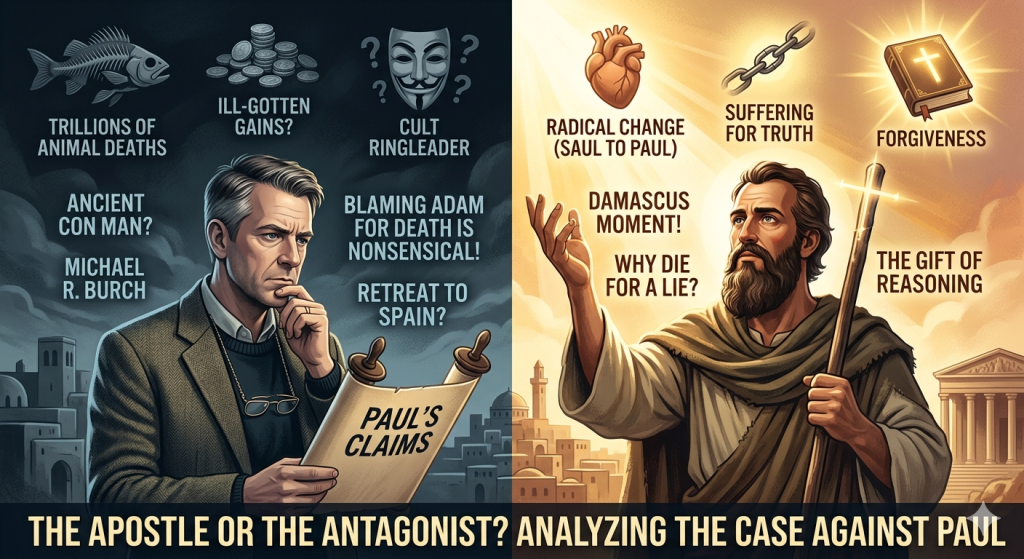
This is a fascinating clash between historical skepticism and theological reasoning. To analyze this for a this article, we have to look at the “Psychology of the Convert” versus the “Cynicism of the Critic.”
The Apostle or the Antagonist? Analyzing the Case Against Paul
The history of the early church is often viewed through two lens: one of divine transformation and one of deep-seated suspicion. A recent argument by critic Michael R. Burch suggests that the Apostle Paul was not a visionary, but a “con man”—a ringleader of a cult who retired in luxury after tricking the masses.
But does this theory hold up under the weight of historical logic and the “gift of reasoning”? Let’s break down the debate.
1. The Conflict of Context: Animal Death vs. Human Sin
Burch’s primary scientific critique is that because animals died for millions of years before humans, Paul’s theology of “death entering through Adam” is nonsensical.
The Counter-Analysis: This argument often misses the theological mark. In the context of Paul’s letters (specifically Romans), the “death” being discussed is the moral and spiritual separation of humanity from God. Paul wasn’t writing a biological textbook; he was addressing the “corruption of the spirit” handed down through generations. To use animal fossils to debunk a message about human salvation is often seen as a category error—a “futile attempt to distract” from the spiritual message.
2. The “Con Man” Hypothesis: Follow the Money?
Burch suggests Paul was “drumming up money” and used the fear of the end-times to enrich himself. He points to Paul’s defensive tone (“I am not lying”) as evidence of guilt.
The Logical Rebuttal: If we use our reasoning, we have to ask: Cui Bono? (Who benefits?)
- The Transformation: Paul (Saul) began as a man of high status, a Pharisee with the power to arrest and execute. He was already “paid” and respected.
- The Result of Conversion: Upon joining the Christians, Paul traded his safety for shipwrecks, stonings, lashings, and multiple imprisonments.
- The “Retirement” Myth: There is no historical evidence that Paul “retired in Spain with ill-gotten gains.” Early church tradition and historical records indicate he was executed in Rome under Emperor Nero.
A con man usually flees when things get “hot.” Paul, instead, walked into the heart of the Roman Empire, knowing it would likely cost him his life.
3. The Power of “Trigger Words”
The use of words like “Cult,” “Ringleader,” and “Gullible” is a classic rhetorical tactic. By framing the early believers as victims of a scam, the critic attempts to bypass the actual message of the Gospel—which was about forgiveness and the removal of “iniquities.”
As our reader noted, these words are designed to “throw people into a frenzy,” replacing objective historical analysis with emotional bias.
4. The Damascus Road: A Psychological Impossibility?
The most difficult hurdle for skeptics like Burch is explaining why a man who hated Christians “with every fiber of his being” would suddenly pivot to becoming their greatest champion.
If it wasn’t a genuine “Damascus Moment,” what was it?
- A con man wouldn’t choose the most hated, persecuted group to lead.
- A liar wouldn’t die for a lie they knew they made up.
Conclusion: The Search for Truth
While critics like Burch may know the Bible “in and out,” their analysis is often filtered through a lens of modern cynicism. The life of Paul remains one of history’s greatest paradoxes. Whether you see him as a brilliant architect of a new faith or a transformed soul, one thing is certain: a man does not usually suffer a lifetime of agony for a scam that offers no earthly reward.
Perhaps, as suggested, the critics are not just searching for errors, but are themselves on a journey toward the truth—waiting for their own “Damascus moment.”
Key Takeaways for the Reader:
- Logical Consistency: Check if the critic’s theory matches the historical outcome (e.g., martyrdom vs. retirement).
- Theological Scope: Distinguish between biological observations and spiritual claims.
- Motive Matters: Always ask what a person stands to gain or lose from their convictions.