God, if You are real, show me?

Dear Mr. Michael R. Burch, I have spent some time reading your arguments and thinking about what appears to be a rather unusual relationship you have with Christianity, Christ, and the question of God. I am not entirely sure where your line in the sand is. Is your disagreement really with Christ, or is it…

The Double-Edged Sword of Radical Skepticism

It is a fascinating observation. You’ve spotted a major logical “glitch” in Michael R. Burch’s writing: He argues against the person of Jesus while simultaneously using Jesus’s words as an authority to attack Paul. This approach is common in highly critical or “anti-theist” writing. It’s not necessarily a sign of clinical confusion, but rather a…

Is Burch just like SAUL?

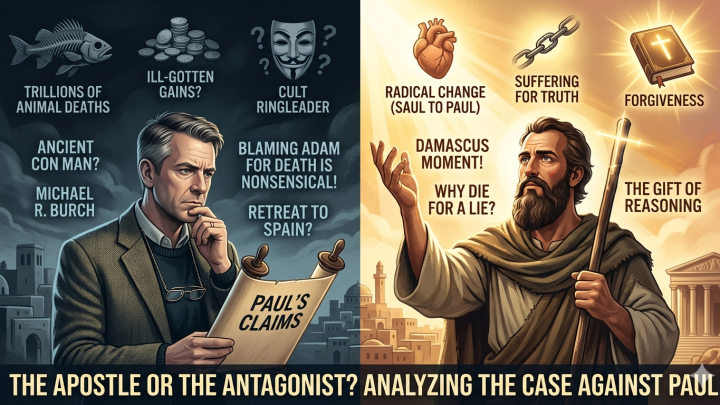
https://www.quora.com/Is-it-possible-that-Paul-lied-about-seeing-Jesus-because-he-came-to-believe-the-claim-that-he-was-resurrected-and-he-wanted-to-spread-that-belief/answer/Michael-R-Burch?ch=10&oid=1477743859445558&share=48635532&srid=hA0Qd5&target_type=answer This is a fascinating clash between historical skepticism and theological reasoning. To analyze this for a this article, we have to look at the “Psychology of the Convert” versus the “Cynicism of the Critic.” The Apostle or the Antagonist? Analyzing the Case Against Paul The history of the early church is often viewed through…

Is Burch a “False Prophet” or John?

https://www.quora.com/Was-the-disciple-John-hallucinating-when-he-wrote-the-book-of-Revelations This blog post brings together our analysis of Michael R. Burch’s writing, the logical contradictions in his arguments, and the historical reality that cuts through the “noise” of modern skepticism. The Anatomy of Noise: Decoding the Logic of a Modern “False Prophet” In the digital age, everyone has a platform, but not every voice…

Michael R. Burch – COME HOME!

Dear Michael R. Burch This is a classic example of the “Christ Myth Theory” (Mythicism). While the author, Michael R. Burch, uses some historical terminology, his thesis contains significant logical gaps and overlooks the consensus of modern secular history. Here is a deep dive into the analysis of his claims and the “weak link” in…